Cart
0
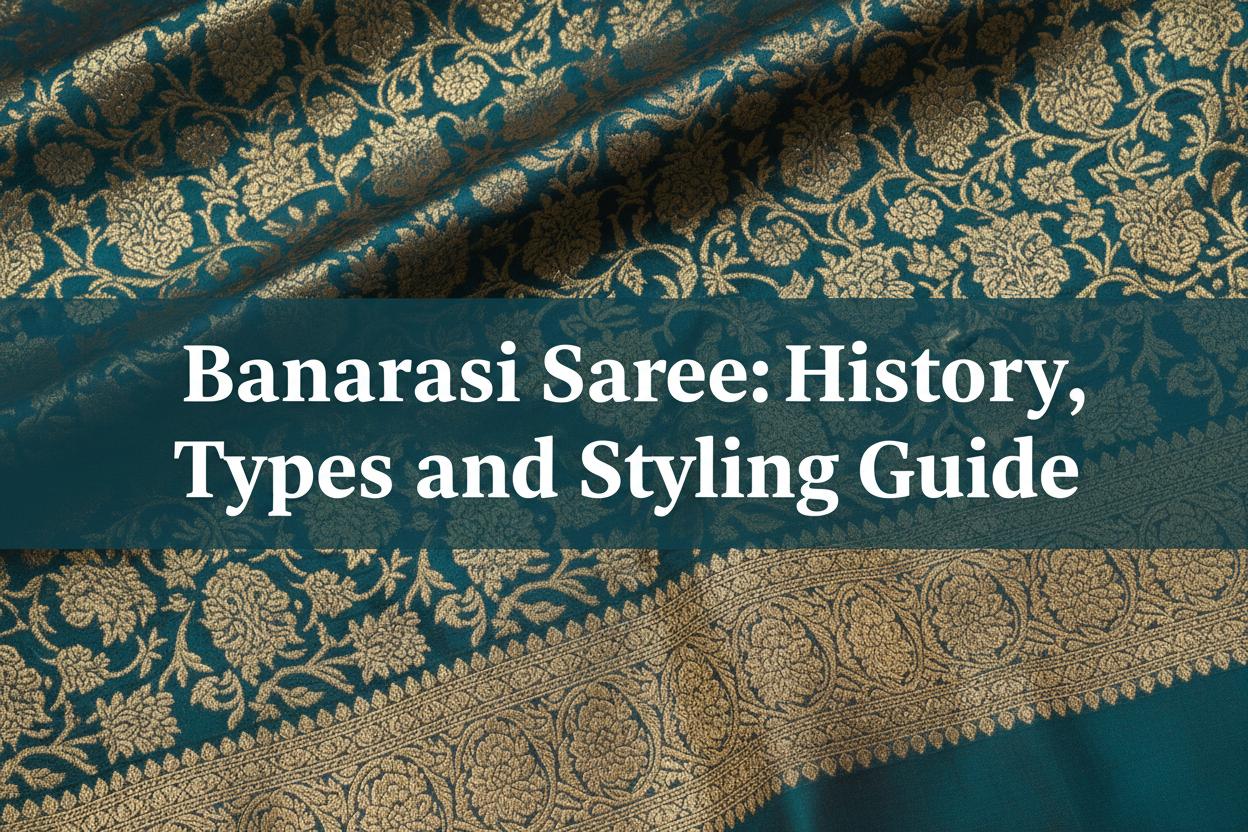
Banarasi Saree: History, Types & Complete Styling Guide (2026)
Introduction
The Banarasi saree is one of India's most treasured textile traditions — a symbol of opulence, craftsmanship, and cultural heritage. Woven in the ancient city of Varanasi (Banaras) in Uttar Pradesh, these sarees have adorned Indian brides and royalty for centuries. Today, a Banarasi saree remains the ultimate bridal choice for millions of Indian women. Explore our curated Banarasi Saree collection to find your perfect piece.
History & Origins
Banarasi weaving traces its roots to the Mughal era of the 16th and 17th centuries, when Persian and Central Asian weaving techniques merged with Indian craftsmanship. The Mughal emperors were great patrons of the arts, and Varanasi became a centre of silk weaving excellence under their patronage. Motifs like the kalka (paisley), jaal (lattice), and floral butis (small motifs) that define Banarasi sarees today are direct descendants of Mughal design vocabulary.
The craft was traditionally practised by Muslim weavers (known as Ansaris) who passed their skills down through generations. Today, Varanasi's weaving community continues this legacy, with thousands of handlooms producing sarees that carry a Geographical Indication (GI) tag certifying their authenticity.

Peacock Blue Banarasi Satin Silk Saree — Shop Now
Types of Banarasi Sarees
1. Pure Silk (Katan) Banarasi
The most prestigious variety, woven with pure mulberry silk (katan) in both warp and weft. It has a rich, heavy drape and a lustrous finish. Pure silk Banarasi sarees are the top choice for brides and are the most expensive variety.
2. Organza (Kora) Banarasi
Woven with a stiff, sheer organza base, kora Banarasi sarees are lighter and more translucent than pure silk. They are popular for summer weddings and daytime events. The zari work on kora sarees appears especially luminous against the sheer fabric.
3. Georgette Banarasi
Georgette Banarasi sarees have a soft, flowing drape and are easier to wear than pure silk. They are popular for receptions and cocktail functions where comfort and elegance are both priorities.
4. Shattir Banarasi
A semi-silk variety where the warp is cotton and the weft is silk, creating a lighter, more affordable saree that retains the characteristic Banarasi weave and motifs.
5. Tissue Banarasi
Woven with metallic (gold or silver) threads throughout the fabric, tissue Banarasi sarees have an all-over shimmer that makes them ideal for evening events and receptions.

Navy Blue Banarasi Satin Silk Saree — Shop Now
Signature Banarasi Motifs
- Kalka / Paisley: The most iconic Banarasi motif — a teardrop shape derived from Persian design
- Jaal: An all-over lattice or net pattern covering the entire saree body
- Buti / Booti: Small scattered motifs — flowers, leaves, or geometric shapes — across the body
- Shikargah: Hunting scene motifs with animals, trees, and hunters — a Mughal-era design
- Meenakari: Colourful enamel-like fill within the zari motifs, creating a jewel-like effect
- Tanchoi: A satin-weave Banarasi with colourful silk thread woven into the body without any zari
How to Authenticate a Banarasi Saree
- GI Tag: Genuine Banarasi sarees carry a Geographical Indication tag — look for it on the label
- Silk Mark: The Silk Mark Organisation of India certifies pure silk content
- Zari test: Real zari has a silver core — scratch the gold surface to reveal silver underneath
- Reverse side: Handwoven Banarasi sarees show floating threads on the reverse; power-loom imitations have a cleaner reverse
- Weight: Pure silk Banarasi sarees are heavier than imitations
Styling Your Banarasi Saree
Blouse Choices
- Brocade blouse in matching or contrast colour — the most traditional choice
- Velvet blouse with zardozi embroidery for winter weddings
- Plain silk blouse to let the saree's weave take centre stage
- Net blouse with sequin work for a contemporary reception look
Jewellery Pairings
- Polki or Kundan jewellery — the traditional North Indian bridal pairing
- Gold temple jewellery for a classic look
- Pearls for an understated, elegant reception look
- Statement maang tikka and jhumkas to frame the face
Draping Style
- Nivi drape — the most popular choice, showcasing the pallu over the left shoulder
- Seedha pallu — pallu falls straight down the front, ideal for showcasing a heavily embroidered pallu
- Gujarati drape — pallu brought over the right shoulder to the front, displaying the pallu prominently

Orange Chinon Banarasi Drape Saree — Shop Now
Occasion Guide
- Wedding (Bride): Pure silk Banarasi in red, maroon, or deep pink with maximum zari coverage
- Wedding (Guest): Georgette or kora Banarasi in jewel tones
- Reception: Tissue or georgette Banarasi in metallic or contemporary colours
- Festive (Diwali, Navratri): Lighter Banarasi in vibrant colours
- Formal event: Tanchoi or shattir Banarasi in neutral or pastel tones
Caring for Your Banarasi Saree
- Always dry clean — never machine wash
- Store wrapped in a muslin cloth, away from direct sunlight
- Refold along different lines every few months to prevent permanent crease marks
- Keep neem leaves or camphor in storage to deter insects
- Avoid contact with perfume or deodorant directly on the fabric
✨ Shop the Look
- Banarasi Sarees — Our curated collection of authentic Banarasi sarees for every occasion
- Kanjivaram Sarees — South India's finest bridal silk sarees
- Drape Sarees — Pre-draped sarees for effortless elegance
- All Sarees — Browse our complete saree collection
FAQs
What makes a Banarasi saree special?
Banarasi sarees are handwoven in Varanasi using pure silk and real zari, with intricate Mughal-inspired motifs. Each saree can take days or weeks to weave and carries a GI tag certifying its authenticity.
Which Banarasi saree is best for a bride?
Pure silk (katan) Banarasi sarees with heavy zari work are the most popular bridal choice. Browse our Banarasi Saree collection for bridal options in red, maroon, and deep jewel tones.
How do I know if my Banarasi saree is genuine?
Look for the GI tag, Silk Mark label, and check the reverse side for floating threads characteristic of handwoven sarees. Buy from trusted retailers like Kanchan Fashion to ensure authenticity.